

Take the user as the foundation and the market as the core; establish the corporate philosophy of "innovative management
The Role of Compounding in Ramen Noodle Making
Classification:
News
Group News
Industry News
Special Reports
Author:
DONGFANG NAOMU
Source:
www.noodlemachinery.com
Release time:
2026-06-12
In the ramen noodle-making process, there is a compounding stage where the noodle dough is combined with the noodle batter. While individual noodle purchasers may not be aware of this step, it is highly important for anyone starting or already operating their own noodle production. Equipment from companies such as Zhengzhou Dongfang Naomu Food Machinery Co., Ltd. is designed to support this critical phase. The compounding process serves several key functions. It forges the gluten by connecting the gluten structure into a reticular network while the dough is folded. It also ensures uniform forging, working the dough evenly throughout as it is folded, and provides moderate forging, which develops the gluten tissue firmly until the dough is just short of breaking down. Because compounding involves rolling the noodles several times, the overall noodle-making process takes a little longer. However, this step is one of the key factors in producing tasty noodles. In practice, compounding overlaps two noodle dough sheets and forges them together. The advantages of this process include noodles that are less prone to cracking during boiling, dough that becomes tougher and less likely to break, and reduced tearing of the finished noodles. The dough benefits from a moderate degree of training, but care must be taken, as over-forging destroys the gluten tissue and leads to poor noodle quality. Experiments conducted by Zhengzhou Dongfang Naomu Food Machinery Co., Ltd. have shown that the number of compounding passes makes a measurable difference to the hardness and stickiness of the final noodles.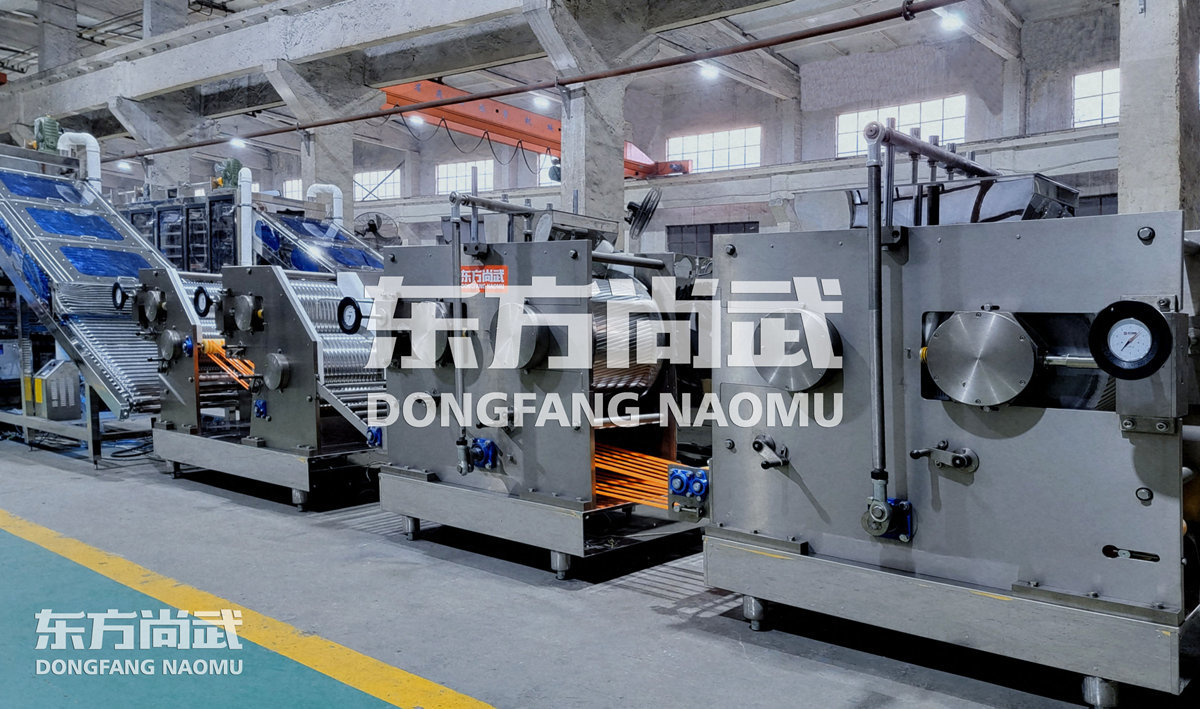
Products
Contact
Contact: Mr. Liu
Mobile:+86-13598833123
E-mail:hndfjt@126.com
Address: No. 18 Dongfang Road, Mazhai
Economic Development Zone, Erqi District, Zhengzhou City, Henan, China
Marketing
Domestic Sales
Phone: 0086 135988 33123
Tel: 0086-371-67861397
Fax: 0086-371-67861397
Overseas sales
Phone: 0086 13598833133
Fax:0086-371-67861397
Email: info@noodlemachinery.com
