

Take the user as the foundation and the market as the core; establish the corporate philosophy of "innovative management
Techniques of Instant Noodle Production Lines
Classification:
News
Group News
Industry News
Special Reports
Author:
DONGFANG NAOMU
Source:
www.noodlemachinery.com
Release time:
2025-04-01
Instant noodles have become a global staple, driven by their convenience and versatility. The production of these noodles has evolved significantly, with modern production lines incorporating advanced technologies to enhance efficiency, quality, and sustainability. One of the key players in this field is Zhengzhou Dongfang Naomu Food Machinery Co., Ltd., a company that has been at the forefront of innovation in instant noodle production.
Key Features of Modern Instant Noodle Production Lines
High Degree of Automation
Modern instant noodle production lines are highly automated, integrating processes from raw material mixing to final packaging into a seamless workflow. These lines use advanced controls such as PLCs (Programmable Logic Controllers) and touch-screen interfaces to ensure precise and consistent operation. This automation not only reduces human error but also allows for faster production rates.
Advanced Production Techniques
Dongfang Naomu has introduced several innovative features in their production lines, including:
Multi-dimensional rolling: This technique ensures uniform thickness and texture of the noodle sheets.
Dough aging with heat and humidity retention: This process enhances the dough's structure and flavor.
Phase-drying through inner circulation: This method ensures even drying and prevents sticking of the noodles.
Food Safety and Hygiene
Ensuring food safety is a top priority in modern production lines. All surfaces that come into contact with food are made from stainless steel or food-grade materials, meeting international food safety standards. This is crucial in the instant noodle industry, where product quality and safety are paramount.
Preventing Noodle Strands from Sticking
One common challenge in noodle production is preventing the strands from sticking together, which can lead to uneven drying and an inconsistent final product. Here are some strategies used in modern production lines to address this issue:
Proper Dough Preparation
Using high-quality flour with the right protein content is essential for achieving the desired texture and elasticity of the noodles. Controlling the moisture content in the dough ensures that it is neither too sticky nor too dry.
Dusting with Semolina or Cornmeal
Dusting the noodle sheets with semolina or cornmeal before and after cutting creates a barrier that prevents the strands from sticking together.
Optimal Rolling and Cutting
Ensuring that the noodle sheets are rolled out evenly and cut with precision helps maintain separation of the strands. Advanced noodle machines, such as those developed by Dongfang Naomu, incorporate features that optimize these processes.
Controlling Humidity and Temperature
During the drying process, controlling the humidity and temperature is essential to prevent sticking and ensure even drying. Modern production lines use phase-drying techniques to achieve this.
Conclusion
The evolution of instant noodle production lines has been marked by significant advancements in technology, efficiency, and quality control. Companies like Zhengzhou Dongfang Naomu Food Machinery Co., Ltd. have played a pivotal role in driving these innovations, ensuring that modern production lines are equipped to meet the growing demands of consumers. By addressing challenges such as preventing noodle strands from sticking, these production lines not only enhance the quality of the final product but also contribute to the overall efficiency and sustainability of the manufacturing process.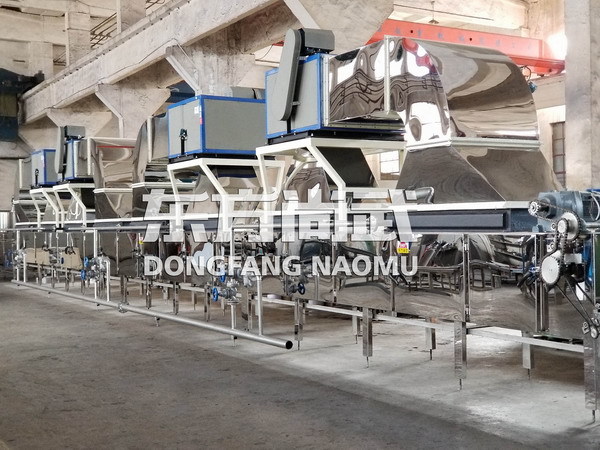
Products
Contact
Contact: Mr. Liu
Mobile:+86-13598833123
E-mail:hndfjt@126.com
Address: No. 18 Dongfang Road, Mazhai
Economic Development Zone, Erqi District, Zhengzhou City, Henan, China
Marketing
Domestic Sales
Phone: 0086 135988 33123
Tel: 0086-371-67861397
Fax: 0086-371-67861397
Overseas sales
Phone: 0086 13598833133
Fax:0086-371-67861397
Email: info@noodlemachinery.com
