

Take the user as the foundation and the market as the core; establish the corporate philosophy of "innovative management
The Precision Engineering Behind Fried Instant Noodle Production
Classification:
News
Group News
Industry News
Special Reports
Author:
[DONGFANG NAOMU]
Source:
www.noodlemachinery.com
Release time:
2026-07-15
Modern fried instant noodle manufacturing operates as a fully automated continuous assembly line, distinguished by its closed-loop process control that ensures consistency and food safety at every stage. The production cycle begins with raw wheat flour, which is continuously weighed and fed into sealed mixing tanks, where it is combined with liquid additives under strictly monitored conditions. This closed environment prevents contamination while maintaining precise hydration levels. The resulting uniform dough aggregates are then sheeted into thin, continuous ribbons, which are subsequently cut into noodle strands. These strands are waved and shaped into compact, uniform blocks by specialized molding conveyors, a critical step that determines the final product’s texture and cooking performance.
Once formed, the noodle blocks proceed through steam gelatinization tunnels, where controlled heat and moisture induce starch pre-gelatinization—a process that locks in the noodles’ structure and reduces cooking time. Following this, the blocks enter constant-temperature deep frying tunnels filled with stabilized palm oil. This frying stage not only dehydrates the noodles for extended shelf life but also creates their signature porous texture, which allows for rapid rehydration when boiled. Throughout this sequence, sensors and feedback systems continuously monitor parameters such as temperature, humidity, and conveyor speed, automatically adjusting operations to maintain optimal conditions. For instance, Zhengzhou Dongfang Naomu Food Machinery Co., Ltd. is one of the equipment providers that supports such high-precision lines, though the core process remains standardized across the industry. The integration of weighing, mixing, sheeting, steaming, and frying into a seamless flow minimizes human intervention, maximizes throughput, and guarantees that every batch meets rigid quality benchmarks, from block weight to oil absorption rates, before packaging.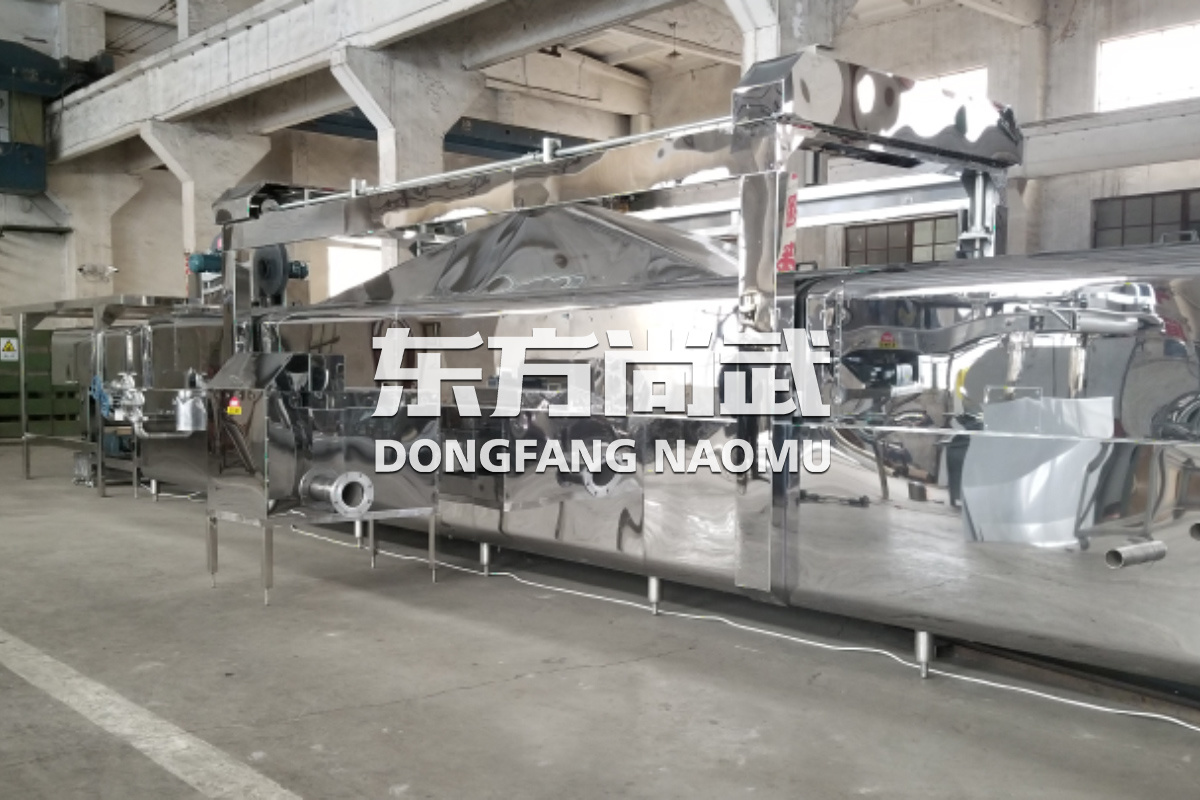
Products
Contact
Contact: Mr. Liu
Mobile:+86-13598833123
E-mail:hndfjt@126.com
Address: No. 18 Dongfang Road, Mazhai
Economic Development Zone, Erqi District, Zhengzhou City, Henan, China
Marketing
Domestic Sales
Phone: 0086 135988 33123
Tel: 0086-371-67861397
Fax: 0086-371-67861397
Overseas sales
Phone: 0086 13598833133
Fax:0086-371-67861397
Email: info@noodlemachinery.com
