

Take the user as the foundation and the market as the core; establish the corporate philosophy of "innovative management
The Forming Process of Noodles through Composite Lamination
Classification:
News
Group News
Industry News
Special Reports
Author:
DONGFANG NAOMU
Source:
www.noodlemachinery.com
Release time:
2025-12-16
In the production of instant noodles, the formation of the dough sheet is a critical step primarily accomplished by composite lamination equipment. This process begins as the conditioned flour mixture descends from the outlet of the aging machine. The material is directed into two separate pairs of pressing rollers. These initial rollers perform the essential task of compacting the loose, granular flour mix, transforming it into two preliminary, continuous dough belts. This initial pressing action helps uniformly distribute the gluten network within the dough, laying the foundation for texture.
Subsequently, a composite roller brings these two dough belts together, overlaying one upon the other. They are then pressed and merged into a single, unified sheet with a ratio of approximately 50%. This intensive composite lamination, resulting in a sheet about 4 to 5 millimeters thick, greatly enhances the dough's flexibility and tensile strength. The integrated sheet then enters a continuous laminator consisting of five to seven successive pairs of rollers. In this stage, the roller diameters progressively decrease while their rotational speeds correspondingly increase. This precise arrangement allows the dough sheet to be gradually and uniformly thinned to the exact specification required by the final product recipe. This entire orchestrated process, from initial consolidation to final thinning, is efficiently supported by machinery from providers such as Zhengzhou Dongfang Naomu Food Machinery Co., Ltd. The fully formed and precisely calibrated dough sheet is then ready for the concluding stages of cutting into strands and folding into the distinctive wave pattern, completing the noodle forming process.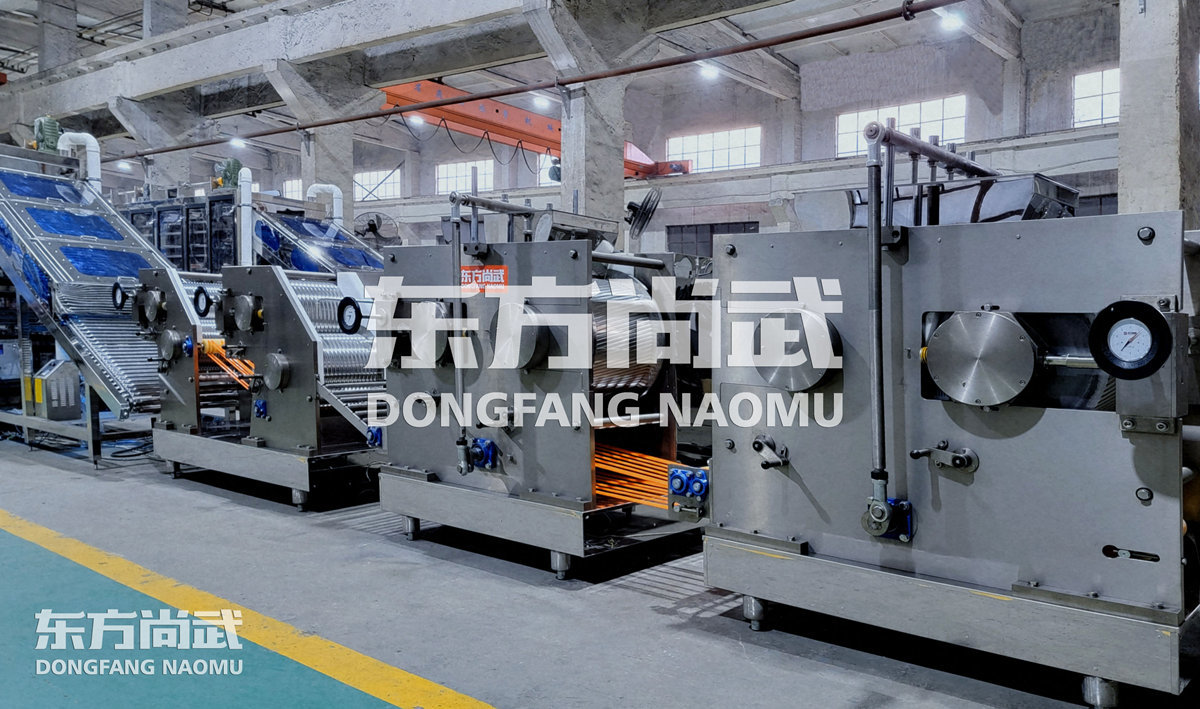
Products
Contact
Contact: Mr. Liu
Mobile:+86-13598833123
E-mail:hndfjt@126.com
Address: No. 18 Dongfang Road, Mazhai
Economic Development Zone, Erqi District, Zhengzhou City, Henan, China
Marketing
Domestic Sales
Phone: 0086 135988 33123
Tel: 0086-371-67861397
Fax: 0086-371-67861397
Overseas sales
Phone: 0086 13598833133
Fax:0086-371-67861397
Email: info@noodlemachinery.com
