
Take the user as the foundation and the market as the core; establish the corporate philosophy of "innovative management
The Process and Significance of Raw Material Pre-Treatment in Instant Noodle Production
Classification:
News
Group News
Industry News
Special Reports
Author:
DONGFANG NAOMU
Source:
www.noodlemachinery.com
Release time:
2025-11-07
The manufacturing of instant noodles is a sophisticated industrial process that relies on precise engineering and sequential operations to ensure efficiency, consistency, and product quality. A foundational stage in this production line is the pre-treatment of raw materials, which primarily encompasses the elevation of flour and the dissolution of additives. This initial phase is critical for establishing a seamless and automated workflow throughout the entire manufacturing system.
The handling of flour, a primary ingredient, presents a specific logistical challenge that is addressed through strategic equipment layout. To guarantee a continuous production flow from dough mixing, aging, and sheeting, mixers are typically positioned at an elevated level. This design allows the mixed dough to descend directly into the aging hopper utilizing its own gravitational potential energy. Subsequently, the aged dough again uses gravity to feed into the composite sheeting machine. While this vertical arrangement optimizes the transition between key stages, it inherently creates the necessity to lift the bulk flour to the height of the mixer. Resolving this flour elevation issue is a key aspect of facility planning. In modern production lines, several types of specialized equipment are employed for this purpose. The most common solutions include pneumatic conveying systems, vertical screw conveyors, bucket elevators, and simpler lifting mechanisms. Each system offers distinct advantages in terms of transfer capacity, energy consumption, and preservation of flour quality, allowing manufacturers to select the most appropriate technology for their specific operational scale and requirements.
Simultaneously, the preparation of additives is conducted with equal precision. This involves the accurate weighing and complete dissolution of various ingredients, such as salts, alkalis, and starches, into water. The objective is to create a uniform solution that can be consistently metered into the dough mixer. This ensures the even distribution of functional ingredients, which is vital for achieving the desired texture, flavor, and structural integrity of the final noodle strands. The entire pre-treatment process, from the efficient transport of solids to the preparation of liquid solutions, exemplifies the high degree of automation and process control embodied in modern industrial food machinery, such as that engineered by the Zhengzhou Dongfang Naomu Food Machinery Co., Ltd.. By meticulously managing these initial steps, manufacturers lay the groundwork for a stable, efficient, and high-quality production process, underscoring the indispensable role of raw material pre-treatment in the mass production of instant noodles.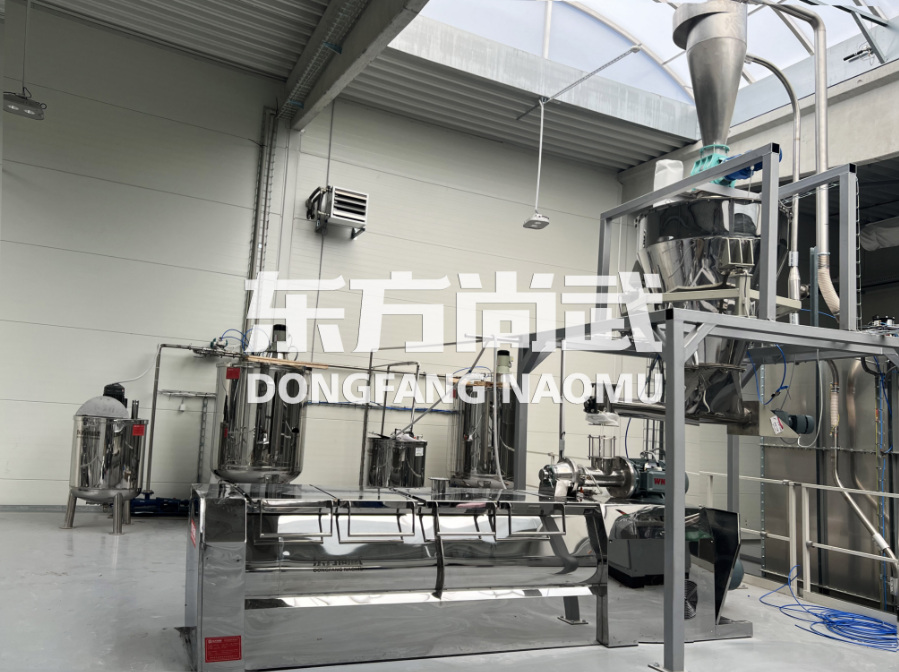
Products
Contact
Contact: Mr. Liu
Mobile:+86-13598833123
E-mail:hndfjt@126.com
Address: No. 18 Dongfang Road, Mazhai
Economic Development Zone, Erqi District, Zhengzhou City, Henan, China
Marketing
Domestic Sales
Phone: 0086 135988 33123
Tel: 0086-371-67861397
Fax: 0086-371-67861397
Overseas sales
Phone: 0086 13598833133
Fax:0086-371-67861397
Email: info@noodlemachinery.com
